
Introducing A New Interview Series

Patrick Leary in Conversation with Matthew Stephens
This interview is the first in a series in which representatives from RSVP’s graduate student community talk to established, senior periodicals scholars about their respective journeys in periodicals research, focusing on how they got started, challenges they overcame and what advice they would want to pass on to researchers relatively new to the study of Victorian periodicals.
The subject of our first interview, Patrick Leary, is a longstanding supporter and former President of the Research Society for Victorian Periodicals. He describes himself, with characteristic modesty, as “Victorianist, scribbler, factotum, historian.” He has been an enthusiastic champion of the development of digital research methods in history, creating the Victorian Research Web and writing extensively on the uses of IT in historical studies, for example in “Googling the Victorians: (Journal of Victorian Culture 10:1). As a result of Patrick’s tireless efforts and innovation, RSVP was delighted to rename its annual Resource Development Grant (which was created with funds from a generous bequest by Eileen Curran) after him at the annual conference in 2023.
Patrick remains highly active in the Society, providing much support and encouragement to newer scholars, for example as a committee member overseeing the Curran Index. His assistance was vital to me (Matthew Stephens) in securing an introduction to the editors of the Waterloo Directory and it was a great pleasure to be able to interact directly with him about his own experiences as a periodicals scholar.
The following interview, centered on “Starting Out in Periodicals Research,” will appear in three serial installments over the next several months. It has been edited for length and clarity.
Getting Started With Periodicals Research
Matthew Stephens: Thinking back over your long career and research journey, what first got you interested in Victorian periodicals?
Patrick Leary: [During] my freshman year in college, while looking for something else in the library, I stumbled across a long corridor lined on both sides with seemingly endless shelves of bound periodicals from the nineteenth century. Some were the size of ordinary books but others were tall and bulky. Roaming down the corridor and pulling out various volumes at random to peek inside, I was mesmerized. Temple Bar, Quarterly Review, Fraser’s Magazine, and dozens more — they were all titles I’d never heard of before, but every page I looked at was alive with observations and arguments of all kinds.
The experience left me curious about the world that had produced these extraordinary things. From my own miscellaneous reading I’d already brushed up against some nineteenth-century British prose, mainly in the form of essays by the likes of Lamb and Hazlitt and John Stuart Mill and so on, and the summer before I’d read the Origin of Species for the first time and found it enchanting and challenging.

Where I grew up, in Texas, the teaching of Darwin and evolution in public schools was still a hotly controversial topic. So, when in my first-year world history survey we had to choose a project for our term paper, I remembered that encounter with the big bound journals and the idea came to me to go find out what reviewers had written about the Origin of Species in the months after it appeared in 1859. This was my very first venture into primary-source research, and I wound up loving it.
Later my undergraduate adviser was the newly arrived L. P. (“Perry”) Curtis, Jr., who had just published a fascinating and much-talked-about book (Apes and Angels: The Irishman in Victorian Caricature). His main sources for the book were drawn from the illustrated press of the period, and they were a revelation to me in more ways than one.
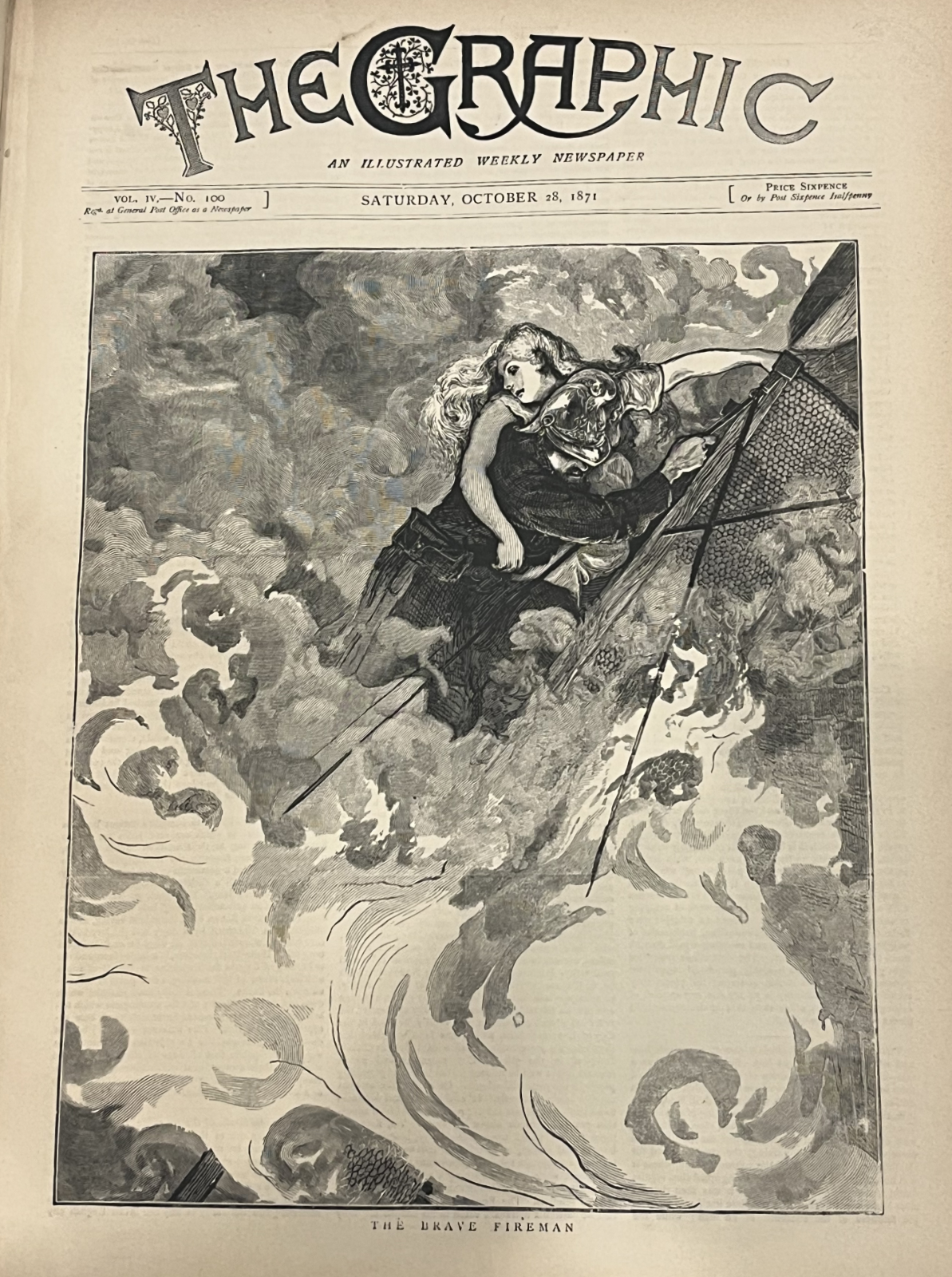
After college I worked in a second-hand bookstore that happened to make a specialty of old newspapers and magazines, which gave me many opportunities to handle individual issues of illustrated papers like The Graphic and the Illustrated London News. Although I never thought of myself as a specialist in such things, all of these early encounters piqued my curiosity about periodicals, and gave me a comfortable familiarity with them, in ways that would prove helpful later on.
MS: How did you conduct your research initially? What resources were available to you when starting out as a periodicals scholar?
PL: Much of my work in periodicals has grown out of a longstanding fascination with the material history of nineteenth century authorship — how writers made a living, particularly, but also how they organized their careers, pursued their social and professional lives, and so on, a subject that seemed to me, when I first began looking into it, to have been curiously neglected. One exception to this neglect was the Wellesley Index and the work of scholars associated with it.
Making Use of What Was Available
In the absence of any British equivalent to Frank Luther Mott’s magisterial survey of American magazines, the Wellesley’s introductions alone, which laid out the histories of the forty quarterlies and monthlies covered by the Index, were an education in themselves, as was [Joan] Shattock and [Michael] Wolff’s edited collection, The Victorian Periodical Press: Samplings and Soundings. Yet most of the handful of existing monograph-length studies of individual Victorian periodicals […] were decades old.
As for the periodicals themselves, I once again was lucky. Prior to grad school I had been able to find much of what I needed at Fondren Library at Rice University, where I worked on a broadly sociological project about the careers of nineteenth-century novelists under the supervision of Bob Patten, who had recently published his study of Dickens’s publishers.
“My experience suggests the value of energetic opportunism in periodicals research. Make use of what you can, when you can.”
The library at Indiana University, Bloomington, where I would go on to earn a Ph.D. in History, boasted an even more substantial collection of bound copies of nineteenth century magazines, all of them on open shelving.
With Thrall’s pioneering but badly dated study in mind, I decided to look at contributors to Fraser’s in light of what could now be gleaned from the Wellesley Index and, particularly, from the files of the Royal Literary Fund, which I was able to obtain on microfilm, a few reels at a time, through Inter-Library Loan from the set at the University of Delaware.
The result was a seminar paper that I was so pleased with that I submitted it to RSVP for the Rosemary VanArsdel essay prize. I didn’t win the prize, but the then editor of Victorian Periodicals Review, Dick Fulton, kindly took an interest in the piece, and in due course it appeared in the journal — my first published article.
Working With Physical Archives
When I started graduate school at IU there were no digital resources to speak of for scholars in the humanities or social sciences […] As a result, many people working on Victorian subjects that involved the press began by manually poring through the volumes of the Wellesley Index, looking for titles of articles that sounded like they might be relevant to the topic at hand.
Having compiled a subject index ordered chronologically by periodical, they would then go to the periodicals themselves — if they were lucky enough to have access to them — and read through each article, taking notes and, on occasion, lugging the volumes to a copy machine to make copies that could be highlighted and scribbled on later.
Microfilm remained a major medium for periodicals research, not only for periodicals themselves — I spent many hours with the London Times on film, as well as weeklies like The Critic that were not on the library’s shelves — but also for archival collections like the Bentley archives and the archive of the RLF. But apart from the Times, the nineteenth-century newspaper press was almost entirely unavailable to scholars in American research libraries in any form […]
Like many people who started their periodicals research in the pre-digital era, I still have boxes of carefully labelled file folders stuffed with highlighted photocopies and fading, waxy printouts from microfilm.
MS: What challenges were posed by the available resources and what did you do to overcome them?
PL: Although I’ve put a lot of effort over the years into advocating for the use and development of digital resources in Victorian Studies, they have played a relatively modest role in my own scholarly practice. One exception was an article on the transatlantic spread of gossip about the state of Dickens’s marriage, a thoroughly enjoyable project that required the use of several digitised collections of both American and British newspapers.
By contrast, the core of my work on Punch relied most heavily upon manuscript sources, as well as on the happy acquisition, on eBay, of a bound set of the magazine that had been languishing for years in the display window of a Pennsylvania bookshop. Yet the mid-2000s advent of the first digitised British newspaper collection, the Times Digital Archive, freed me from [my] reliance on microfilm […] more recently, the British Newspaper Archive in particular has proved enormously helpful in annotating Henry Silver’s diary of Punch table-talk.
Advice for Overcoming Challenges
But to more directly address the “overcoming challenges” point of your question, my experience suggests the value of energetic opportunism in periodicals research. Make use of what you can, when you can. There are enough freely accessible online resources available to periodical scholars—from my own compilation of open access nineteenth-century periodicals to projects like The Yellow Nineties and the Curran Index — that you can frequently use them as workarounds or even substitutes for resources that reside behind commercial paywalls in large research libraries.
If your own institution’s library doesn’t subscribe to a particular database, find out the nearest one that does, and how you can, if necessary, get guest privileges there. In the early stages of a project, conversations with librarians and archivists can be a huge help; rather than simply presenting them with a list of items you think you need, try describing your tentative aims for the project and encouraging them to help you figure out how to achieve them.
Likewise, don’t be shy about asking senior scholars for help, either individually or on social media […] Looking back, I’m abashed to think how forward I was […] sauntering into Bob Patten’s office one day and quizzing him about his book; phoning legendary editor Jack Robson in Toronto for guidance on John Stuart Mill’s correspondents; writing Richard Altick about navigating Punch records. But I’m very glad I did: all three were as kind and encouraging as they could be. It can’t hurt to ask.
And finally, if you can, try to attend an RSVP conference: present a paper, listen to what others are working on and ask questions about it; talk over your project with other scholars, old and young. There is no more supportive and encouraging a scholarly community anywhere.
