
Getting Started in Periodicals Research: Finale

Alternative Sources of Knowledge
Patrick Leary: Among the many primary sources for nineteenth-century periodicals research, I’d like to make a special plea for one genre that seems to me to have been too often neglected: the literary memoir. There are a great many of these, and most were written by indisputably “minor” figures, which might be a drawback for the general reader but turns out to be an advantage for the student of periodicals because it was minor writers, after all, who filled up most of the pages of the periodical press. And not only writers, but printers, engravers, and artists, too.
There is more to be learned about the evolution of the illustrated press from a close reading of Henry Vizetelly’s Glances Back Through Seventy Years than from any number of secondary studies. […] These accounts lean heavily to the ramblingly anecdotal and the pickings of useful information can be slim. But, at their best and taken together, they can help put flesh on the bones of dry data about literary […], filling in the critical emotional contexts of the rivalries and allegiances that organized social and professional life.
Finally, a few words about manuscript sources, many of which will neither have been digitized in any way nor item-level catalogued in the finding aid. Be indefatigably curious, diligent, and aggressive in seeking these out, not forgetting the often-unexplored holdings of county and municipal repositories.
What Good Archival Research Can Reveal
PL: Victorian periodicals scholarship has benefitted enormously from archival research. For example:
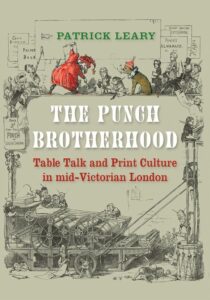 My own book on Punch would have been impossible without resort to surviving unpublished ledgers, correspondence, and diaries. (I live in hope that other scholars will return to the Bradbury & Evans papers, in the British Library and the Bodleian, to write about other authors, books, and periodicals that the firm published.)
 David Finkelstein’s work on Blackwood’s, based on the firm’s archives at the National Library of Scotland, has illuminated more than simply the history of that publisher — we would not know some very important facts about Mudie’s Circulating Library, for instance, if it weren’t for David’s sleuthing there. The same archive has benefited almost every scholar who has written about the authors that Blackwood’s published — all work on Oliphant’s career, for instance, must rely heavily on it.
Graham Law‘s important book on the newspaper serialization of fiction was largely made possible by the surviving papers of Tillotson’s Fiction Bureau, and his new book about Eneas Sweetland Dallas makes extensive use of the archives of the Times.

Martin Hewitt‘s The Dawn of the Cheap Press revolves around the archives of the Association for the Promotion of the Repeal of the Taxes on Knowledge, while also making use of many other archival sources such as the then-unpublished letters of Richard Cobden.
Work on Dickens’s career as a magazine editor is a prime example of how the use of publishers’ archives has enriched our understanding, particularly his correspondence with Wills but also with Gaskell and Collins and many others. Bob Patten‘s indispensable Charles Dickens and His Publishers draws upon many archival sources, including the Bentley archives and what survives of Chapman and Hall’s papers.
Leslie Howsam‘s work, although not focused primarily on periodicals, represents a deft use of archival sources, especially in her books on Kegan Paul and on the British and Foreign Bible Society, both based on the publishers’ archives.
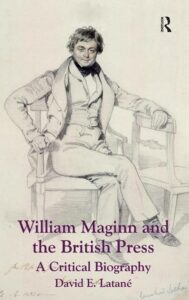 David Latané spent years tracking down manuscript sources for his book about William Maginn, which immeasurably enriched his treatment of Fraser’s Magazine; important records about Fraser’s survive as part of Longman’s archives at the University of Reading. In fact, I don’t see how anybody could write extensively about Longman’s Magazine or Macmillan’s Magazine without making the trek to Reading to consult the archives there.

Without the then-unpublished diaries of journalist Anthony Hewitson, Andrew Hobbs‘s landmark book on the provincial press would have been infinitely poorer; those diaries bring the experience and personality of a nineteenth-century journalist vividly to life.
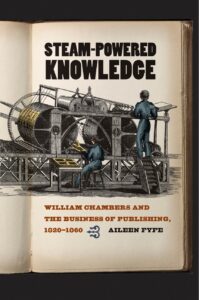 Ayleen Fyfe‘s Colby Prize-winning book, Steam-Powered Knowledge, was made possible by the Chambers archives at the National Library of Scotland, and that same archive is yielding a lot of information about the anonymous poets who published in periodicals, as the Digital Victorian Poetry Project shows.
Patricia Srebrnik‘s biography of Alexander Strahan, publisher of Good Words and other periodicals, draws from a number of archives, including that of George Bell & Sons.
“When you hold a page in your hands that was held by another hand a century and a half ago when the ink was still wet, and realize that what’s written there speaks to a question you’ve been asking, or opens a door to new questions you hadn’t imagined, you will feel in your very bones the capacity of archival research to shape and revitalize your entire project.”
MS: Patrick, your passion and enthusiasm are infectious! Thank you so much for such generous responses. Would you like to offer any closing thoughts for visitors to the RSVP web pages?
PL: Archival research doesn’t have the immediate payoff for minimal effort that makes database and full-text digital searching so seductive; the varieties of nineteenth-century handwriting can be maddening to decipher and you may spend hours or days poring over faded ledger pages or puzzling your way through bundles of correspondence with little to show for it.
But archives have a seductive power of their own, and when you hold a page in your hands that was held by another hand a century and a half ago when the ink was still wet, and realize that what’s written there speaks to a question you’ve been asking, or opens a door to new questions you hadn’t imagined, you will feel in your very bones the capacity of archival research to shape and revitalize your entire project.
