

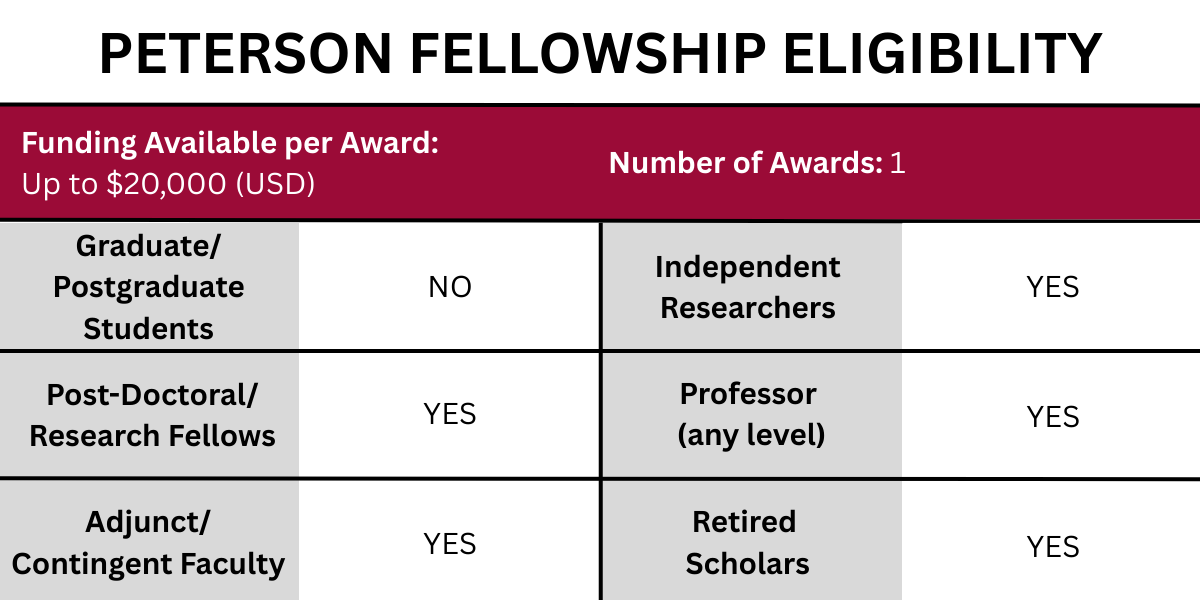
The Linda H. Peterson Fellowship was named after the widely influential Yale professor and longtime RSVP Board member and Vice President, Linda Peterson. The purpose of the Peterson Fellowship is to support one scholar for four full-time months to enable him or her to conduct a research project on the British periodical and newspaper press of the long nineteenth century. It was created with funds from a generous bequest to RSVP by the late Eileen Curran, pioneering researcher and Emerita Professor of English at Colby College. See the list of previous awardees here.
Peterson Fellowship winners are typically announced in February of the prize year. See our awards calendar for all application and recommendation letter deadlines. Please note that deadlines are subject to change and if needed, will be announced via our social media channels promptly.
Please note that Officers and Directors of RSVP are prohibited from applying for RSVP grants and fellowships. Please contact RSVP with any questions.
For most awards, grants, and prizes (with the exception of the Microgrants program), RSVP does not require applicants to be a member of RSVP, but we urge all who receive funding and recognition to join our community by becoming a member of the organization.
Our Most Recent Peterson Fellowship Winner
Our 2026 Linda H. Peterson Fellowship winner is Clare Clark (Trinity College, Dublin) for her project, “Confidential Inquiries: The Untold History of the Victorian Detective in the Periodical Press.” Of Clare’s project, the adjudicating committee wrote: “This is a path-breaking book project that promises to advance scholarly understanding of the relationship between the rise of the detective figure and the expansion of popular periodicals and newspapers at the fin de siècle. It promises a new angle on a familiar figure by applying a lens of periodical literature, in particular the reciprocity of publicity for the detective and the press and the juxtaposition of real and fictional detectives. Periodicals play a central role in the argument of the monograph. The project builds upon Clarke’s stellar reputation as an established, productive scholar of periodical studies and detective fiction.” Congratulations Clare!