
Join us June 12 for South Africa, 1904
A Collaboration Between RSVP and NAVSA’s Empire & Colonialism Caucus
RSVP and the Empire & Colonialism Caucus of the North American Victorian Studies Association (NAVSA) came together to organize a joint Pick-a-Periodical event and Caucus Salon on Friday, June 12 featuring Dr. Gigi Tang. Participants learned about the periodical South Africa and how Dr. Tang uses it in her research, followed by an interactive discussion guided by Dr. Tang of the 1904 issue of the periodical.
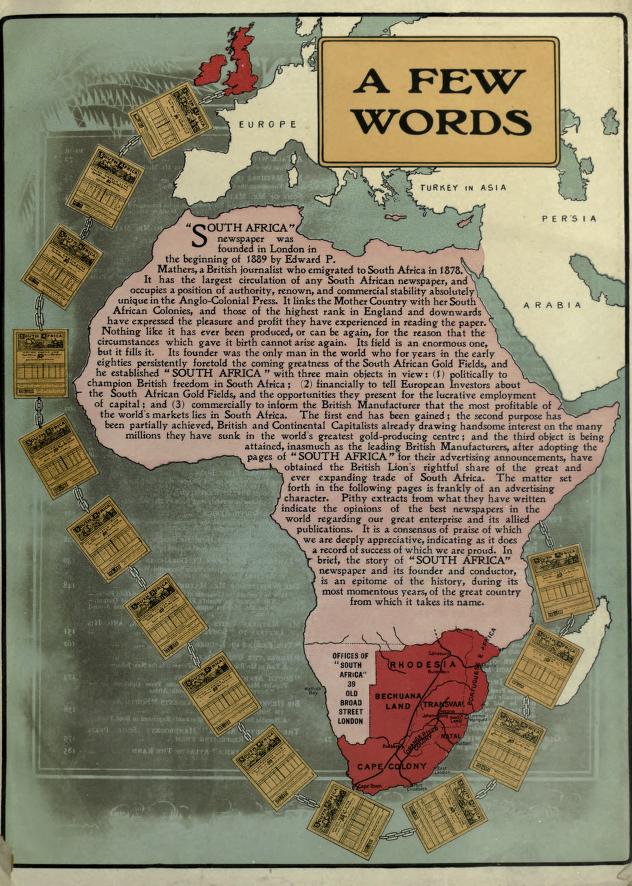
This event invited participants to explore the role of periodicals in promoting racial capitalism and the extractive mining industry through South Africa: A Weekly Journal for All Interested in South African Affairs (1889–1961). Founded by Edward P. Mathers, this weekly was established to promote British investment in South African mining — gold and diamonds — and to serve as the link of communication between European capital and South Africa. The 1904 issue we looked at arrived at a critical moment: the importation of indentured Chinese labourers to the Witwatersrand gold mines, one of the most controversial labour schemes in the history of South African and imperial mining.
Please note that this event was not recorded. Instead, following Dr. Tang’s opening remarks, participants went into break-out rooms to review pre-chosen pages (1-2 pages), and discussed the following:
- How might reading across genres in South Africa, and attending to the periodical’s form, for instance, its layout, seriality, and juxtapositions, generate new understandings of extractivism, racial capitalism, and their representation?
- In other words, when we read how different parts sit together in one issue, what does the weekly manage to do that no single article could?
For the purposes of this salon-style conversation, attendees considered form as both:
- The types/ genres of material a page carries: illustrated headings, news, letters, photography, charts or tables, laws and regulations, poetry, advertising, and more
- How they are put together, including the layout (columns, headlines, what is placed next to what), the recurring shape, and the look of the object itself (its cover, masthead, and special supplements)
About Our Speaker
Dr. Gigi Tang completed her Ph.D. at the University of Melbourne in early 2024. She is currently a postdoctoral research fellow in the School of English at University College Dublin, working on the Research Ireland–funded project “Minerals” (led by Associate Professor Sarah Comyn). Her postdoctoral project investigates the intersecting representations of extractivism, infrastructure, and global networks, with a focus on Chinese workers on the goldfields. By analysing a diverse archive of photography, postcards, goldfield songs, petitions, and reminiscences, she seeks to recover the multifaceted experiences of extractive labour.
